
Devin Vassell has become everything the Spurs needed him to be
The veteran wing is an integral two-way force as San Antonio sits two wins shy of a Western Conference crown

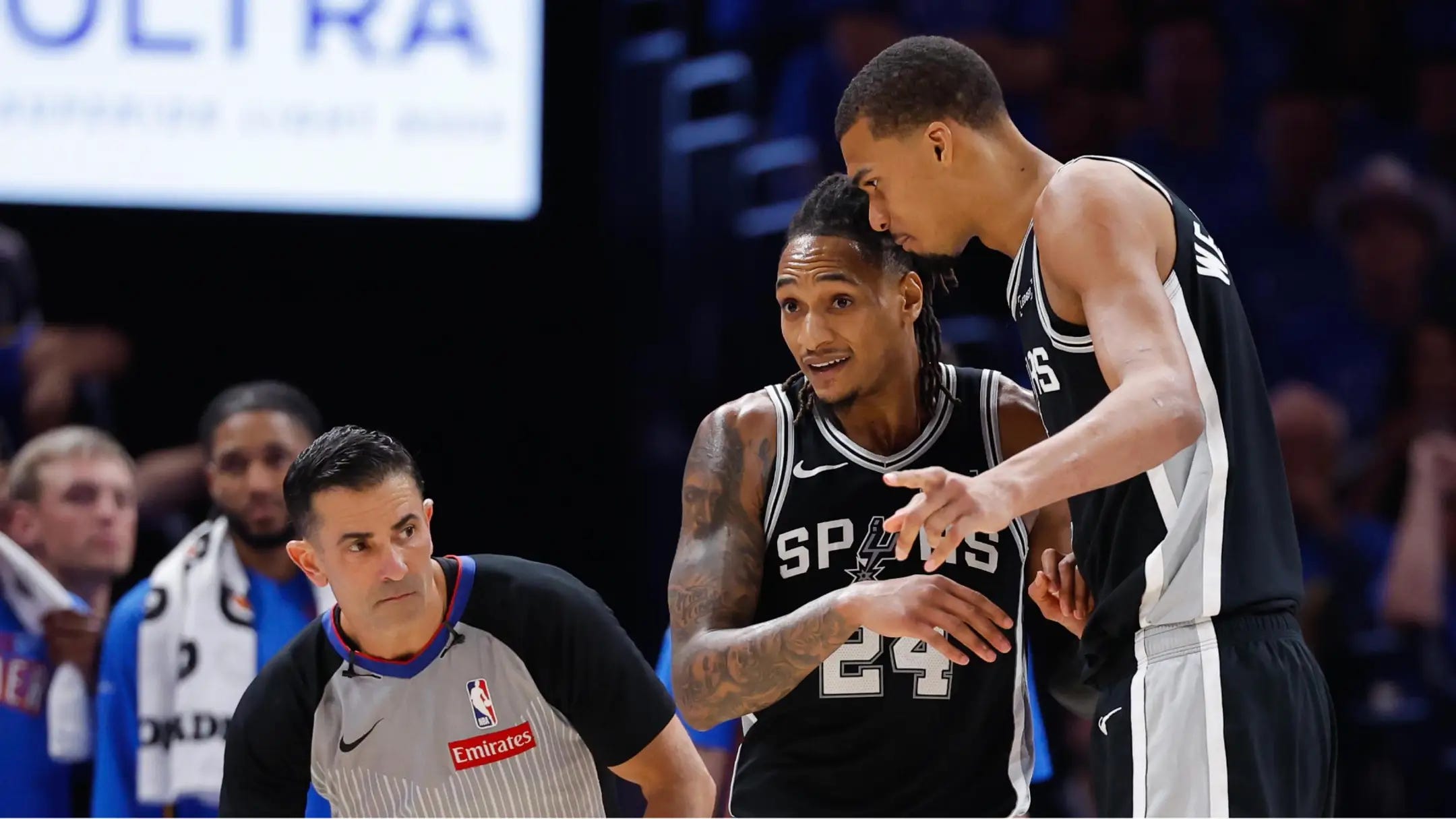
Nearly seven years ago, Devin Vassell was plying his trade at Florida State and looked like one of the league’s next premier 3-and-D wings. As his sophomore season progressed, Vassell continued raining 3s — shooting 41.5 percent from deep — while adding off-the-bounce scoring and helping anchor one of the country’s top defenses.
Track in-game, real-time analytics and lineup data with React Live.
Once the COVID-delayed 2020 NBA Draft rolled around in mid-November, Vassell had solidified himself as a projected lottery pick, wowing with vast shot-making and rarified off-ball instincts defensively en route to being selected 11th overall by the San Antonio Spurs.
Early in his career, Vassell’s defensive prowess popped and he previewed All-Defensive Team potential. But San Antonio grew discontent with early postseason exits and pivoted toward a rebuild, leaving Vassell without much infrastructure around him on either end.
During those lean years, the wiry wing was thrust into a substantial offensive role as the Spurs aimed to gauge the full scope of his possibilities. They knew he could shoot, move keenly off the ball and drill the occasional pull-up. But what if there was more to explore and feature when the fruits of San Antonio’s rebuild bore winning again?
Between 2022-23 and 2024-25, Vassell’s usage rate ballooned to 23.2 percent, per Basketball-Reference (up from 17.3 percent his first two seasons). That offensive upscale precipitated a defensive backslide on and off the ball. Overburdened offensively, Vassell’s all-around game was suffering.
This season, though, the surrounding hierarchy has enabled Vassell to transition back into complementary casting, playing off of De’Aaron Fox, Stephon Castle, Victor Wembanyama and Dylan Harper. His usage rate is down to 18.0 percent and a far greater share of his field goals are assisted, resembling that of 2020-21 and 2021-22.
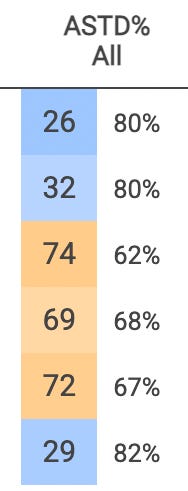
That offensive recalibration has ignited a defensive renaissance, both in the regular season and particularly in the playoffs, where he’s flying around like he’s back in Seminole garnet and gold. He’s found footing in an optimized role on both sides of the ball, growing into precisely the sort of player San Antonio — and many others — envisioned he could become more than half a decade ago.
His on-court harmony is peaking against the Oklahoma City Thunder in these Western Conference Finals, which are locked at 2-2 ahead of Tuesday’s Game 5. Through four outings, the sixth-year forward is averaging 17.0 points (67 percent true shooting, 40 percent from 3), 5.0 rebounds, 1.5 steals and 1.0 blocks. He’s thriving as an off-ball shot-maker and assuming grueling defensive duties.
Although the Thunder’s tenacity, cohesion and playmaking often allow them to defend bigger than they are, the reality remains this is predominantly a bunch of backcourt-sized stoppers on the perimeter. Playing larger than one’s size is not a limitless reality and Vassell is imposing a cap on their efforts.
His elevated release and bouncy vertical pop permit him to rise over Oklahoma City’s cadre of guards for clean looks, whether it’s off the catch or off the bounce. According to NBA.com, he’s canned 39.3 percent (11-of-28) of his catch-and-shoot triples and 53.8 percent (7-of-13) of all pull-up attempts.
With the Thunder’s foremost defenders typically locked onto Fox, Castle and Harper, Vassell is facing lesser options and periodically wielding his creation chops to punish those matchups. When the ball whirls his way, he’s shooting fearlessly, regardless of the contest.
He’s been a dynamite, versatile release valve whose nearly sole job offensively is to shoot, space and move. Nobody’s logged more minutes in this series than his 157, yet he ranks ninth in potential assists (12), per NBA.com. That’s how it should be when he’s lacing jumpers like these:
While Vassell’s leveled up his efficiency in the Western Conference, this type of scoring and off-ball presence have amplified San Antonio’s offense all season. Conversely, he’s transported his defense back to collegiate caliber in the playoffs and is performing like one of the league’s best on that end.
Oklahoma City entered this series averaging a playoff-leading 126.3 points per 100 possessions. Thus far, the Spurs are cornering them into a 107.5 offensive rating. Vassell is fundamental to that, exhibiting why he sits fourth in Defensive Estimated Plus-Minus this postseason behind a trio of All-Defensive honorees in Wembanyama, Ausar Thompson and Cason Wallace.
During his days at Florida State, one of Vassell’s more niche defensive skills (less heralded than the help rotations and playmaking) was how well he fared against big men off the ball. He excelled fronting in the post to prevent entry passes and denying them touches on the perimeter.
San Antonio’s tapping into that acumen, typically stashing him on Chet Holmgren, who’s failed to generate much rhythm or significant scoring volume (11.3 points per game, 32 total shots). According to databallr, Vassell has been Holmgren’s primary defender for 65.2 possessions and held him to seven points on a 39 effective field goal percentage (8.1 points per 75).
Vassell’s propensity for stymying handoffs, interior seals, flare screens and 3s or drives off the catch has diminished the All-NBA center, who averaged 18.6 points on 70 percent true shooting in the first two rounds of the playoffs.
When he’s not wrangling with Holmgren, he’s offering Castle a breather against Shai Gilgeous-Alexander and distorting the two-time MVP’s scoring signature. His length (6-foot-10 wingspan) and body control are routinely crowding Gilgeous-Alexander’s air space in the midrange, where he accomplishes most of his work.
Through the first three games of this series, the Spurs devoted about as much defensive attention as possible to Gilgeous-Alexander. They denied him off the ball, trapped his touches seemingly anywhere on the court and loaded high, early help in the gaps to disincentivize drives.
Doing so, however, left Oklahoma City’s role players open countless times and simplified Gilgeous-Alexander’s passing reads to find them. In Game 4, San Antonio tweaked that approach. It showed softer help in the gaps to shorten closeouts back to shooters and rarely, if ever, sent hard double-teams toward him.
As a result, the Thunder’s 3-point rate dropped from 43.1 percent in Games 1-3 down to 36.2 percent Sunday night, including 33.8 percent before the fourth quarter, when Oklahoma City effectively waved the white flag and did not play Gilgeous-Alexander for a single second.
The efficacy of that tactic hinged on Castle and Vassell’s individual defense against Gilgeous-Alexander. If help was going to be less pronounced behind them, they had to stay attached at the point of attack, sit down on shot fakes and impede his rhythm off the bounce — and they did. He posted 19 points on 6-of-15 shooting and seven assists to four turnovers in Game 4.
According to databallr, Vassell’s guarded Gilgeous-Alexander for 57.3 possessions and flummoxed him into 14 points on a 29 effective field goal percentage (18.3 points per 75). All series, he’s fractured Oklahoma City’s offensive intentions in numerous manners by bottling up its engine, jamming actions off the ball and sparking takeaways.
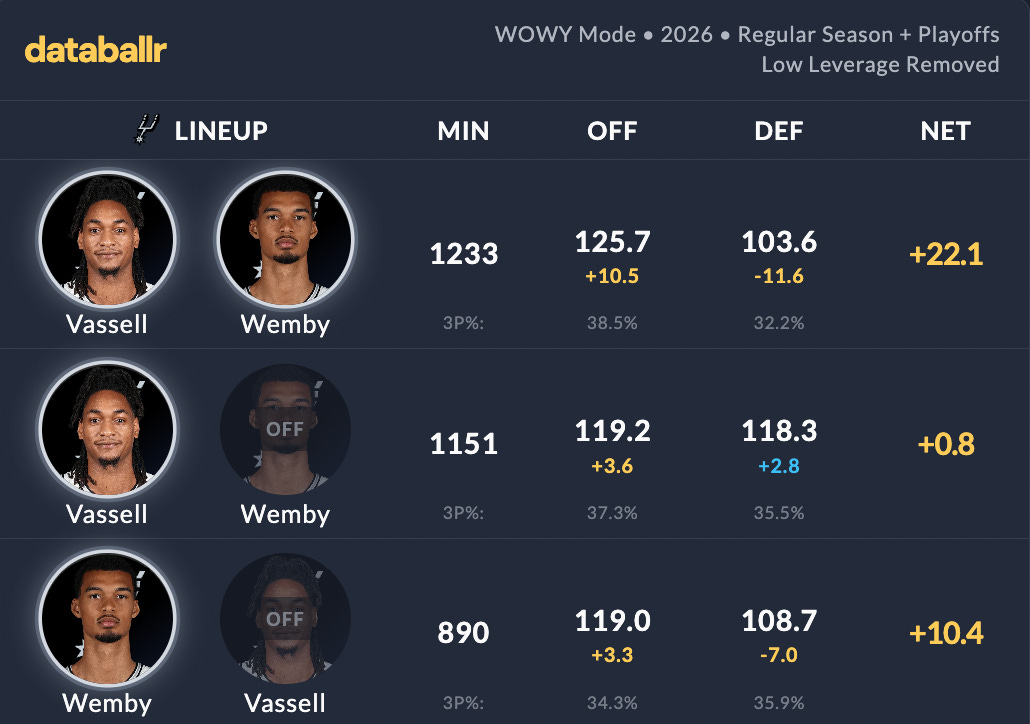
Beyond his own individual talents, Vassell’s grandest value for this Spurs team is his concordance with Wembanyama. His defense, shooting, synergy in off-ball screening actions and knack for feeding lobs to the French phenom combine for overflowing impact.
During the regular season, their net rating with those two on the floor was plus-20.9, a mark bested only by Harper among Wembanyama’s two-man duos throughout the rotation. In the playoffs, their net rating is plus-22.9, the top mark of any full-time rotation player alongside Wembanyama. In this series, they’ve outscored Oklahoma City by 57 points in 127 minutes (plus-19.0 net rating).
Wembanyana survives much better without Vassell than vice versa but they augment one another like nobody else does for Wembanyama on this Spurs roster:
After a spike in usage rate ignited gaudy box scores and a subdued defensive ethos, it may have been easy for San Antonio to abandon hope on the pre-draft vision of Vassell. Instead, the Spurs stuck by him and reshaped the environment around him. Then, he became precisely the player his proponents imagined many years ago.
It’s a testament to his adaptability — embracing evolution without forgetting his most prosperous on-court identity — the faith of the front office and the potency of this present-day roster, which is within arm’s reach of the franchise’s first NBA Finals appearance in 12 years.
That conclusion is not possible if Vassell does not emerge from the trials of the early 2020s to rediscover who he could always be: someone perfectly suited to revel in the high-level, title-contending basketball exuded by San Antonio all postseason long.
bro saved my life
Great Post!
I always thought Vassell was a great wing who didn’t get the respect he deserved while San Antonio was rebuilding. I felt similarly about Keldon Johnson, but he seems to have gotten his flowers this year by winning 6MOTY.
The Spurs have drafted and rebuilt so well over the past years that I have nothing but respect for their franchise. Even as Pop has retired, they are keeping the legacy of the spurs alive.
Can’t wait to read more!