
Some thoughts on Giannis joining the Heat
As a result of Monday's blockbuster trade agreement, the two-time MVP will team up with Bam Adebayo in South Beach. What might that look like?

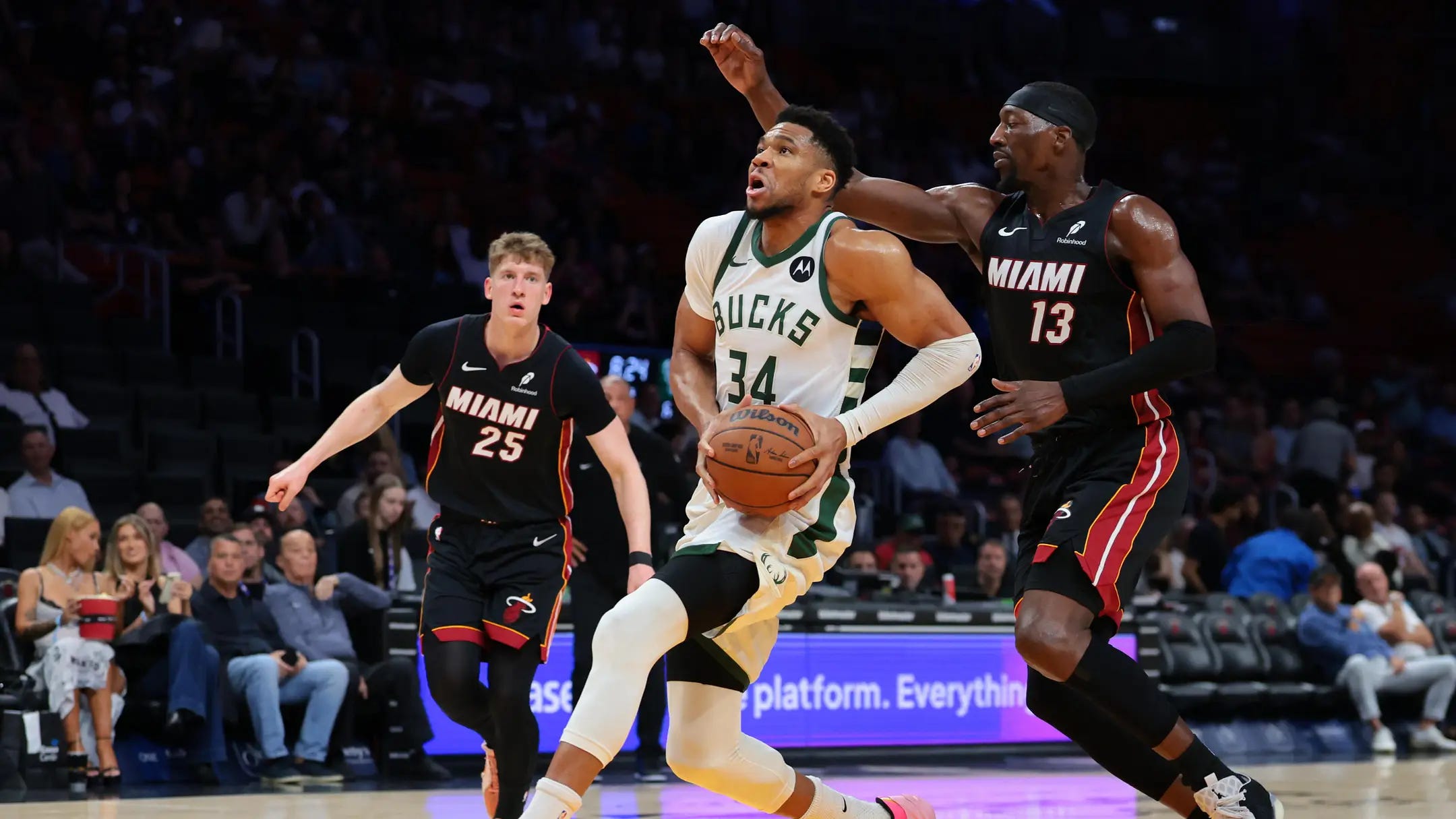
After many, many months of vague comments, half-hearted commitments, and repetitive rumors and reporting, Giannis Antentokounmpo and the Milwaukee Bucks will finally end their 13-year partnership later this summer. According to ESPN’s Shams Charania, Milwaukee is sending Antetokounmpo and Bobby Portis Jr. to the Miami Heat in exchange for a slew of players and picks. The full details are here:
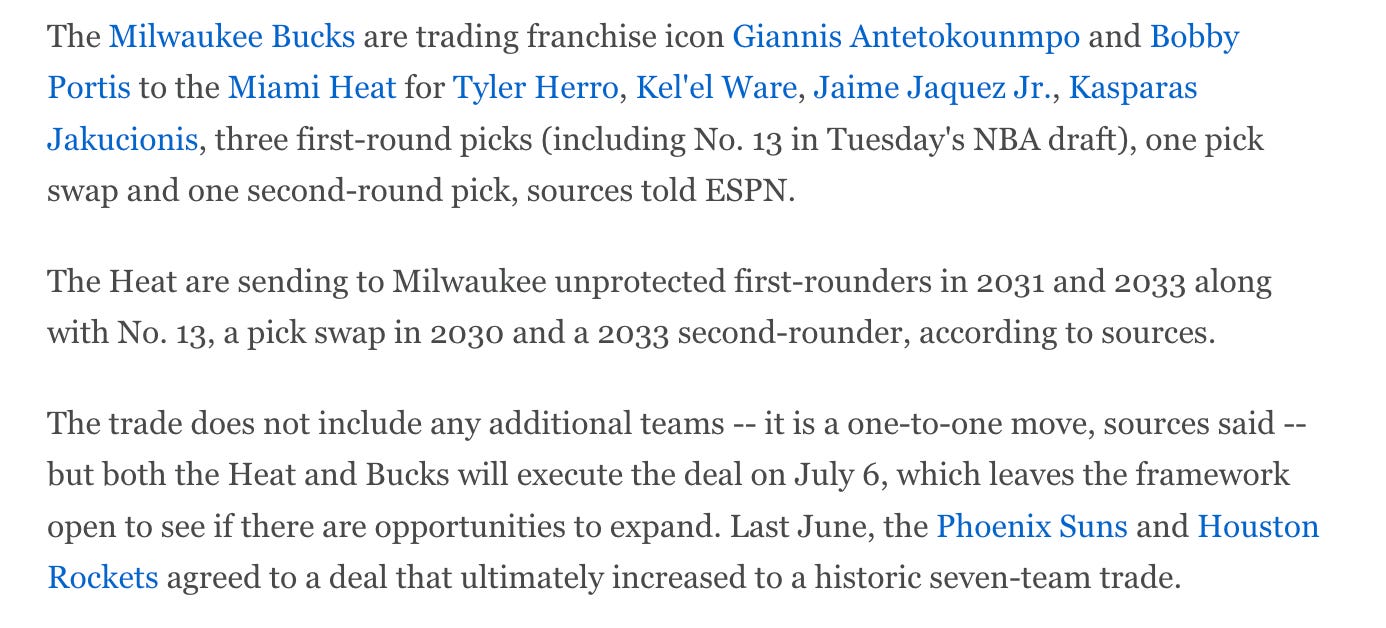
For years, the Heat have been interested in Antetokounmpo and they’ve finally won the sweepstakes to team him with their franchise pillar, Bam Adebayo. Such a move will drastically reshape them, as any trade prompting the departure of three rotation players (and a fourth on the fringe) in exchange for a galactic superstar like Antetokounmpo would.
As Charania outlines above, this deal won’t be finalized for another couple weeks, leaving plenty of time for further specifics to be ironed out. But there’s nonetheless still plenty to analyze and pontificate about regarding Antetokounmpo’s soon-to-be southbound sojourn.
Here are some early thoughts pertaining to the move.
Track in-game, real-time analytics and lineup data with React Live.
There’s work to do offensively but I’m intrigued
While Adebayo has worked to expand his range from deep — averaging 5.9 3-point attempts per 100 (33.2 percent shooting) the past two seasons — his volume uptick has not really altered how defenses treat him before this transformation. He’s an in-transit stretch big, a vast shift from Antetokounmpo’s prior center pairings, Brook Lopez and Myles Turner, who were bona fide outside shooters.
Despite that pivot for Antetokounmpo, I’m pretty optimistic about how these two may fit together and how they’ll uplift a Miami offense that’s finished among the top 10 in offensive rating just once (2019-20) — including five bottom-10 placements — since LeBron James left in 2014, according to Cleaning the Glass.
Before I dive into details about their potential congruence, I want to lay out the ethereal offensive force Antetokounmpo is to let us digest the magnitude of greatness Miami has landed.
Over the past five seasons, he is averaging 30.1 points (63.1 percent true shooting), 11.5 rebounds and 6.1 assists (3.4 turnovers) per game. He hasn’t ranked lower than the 97th percentile in Offensive Estimated Plus-Minus during that span.
Last year, in an injury riddled season while playing 28.9 minutes a night, he averaged 27.6 points (65.8 percent true shooting), 9.8 rebounds and 5.4 assists (3.2 turnovers). His plus-5.8 O-EPM was a career-high and sixth league-wide. This dude is unbelievably great and will play for the Heat next season.
Simmer on that. Absorb it. Soak it in.
Now, I’ll get back to the nitty gritty.
Both Adebayo and Antetokounmpo tout elite mobility and coordination. They’re both high-level passers who can dribble competently. Adebayo is a premier screener. Antetokounmpo is a keen cutter, particularly from the wings and on duck-ins to the rim.
Their distinct blend of movement, speed, ball-handling and size can be leveraged in various ways to help compensate for the shooting woes each presents to differing degrees. Head coach Erik Spoelstra’s off-ball-movement-heavy mantra should aptly complement those traits.
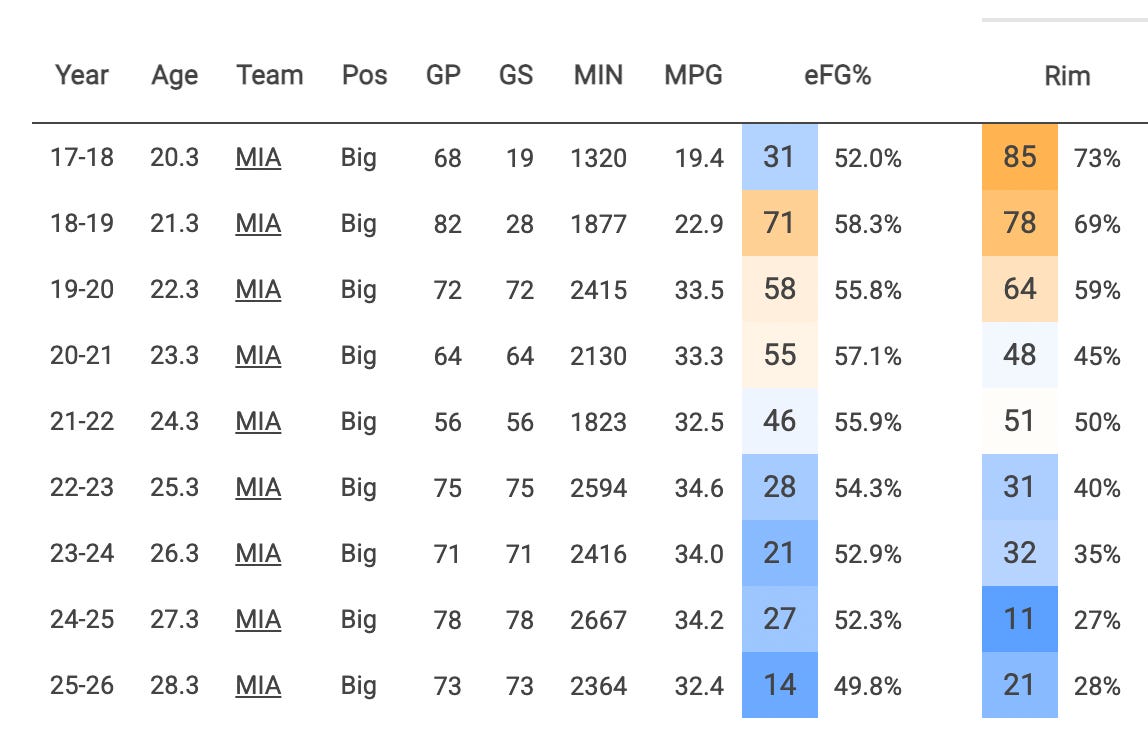
Adebayo will likely continue routinely operating on the perimeter (career-high 7.8 3-point attempts per 100, 31.8 percent shooting last year). But it’s plausible Antetokounmpo’s arrival helps revitalize his interior scoring rate, which has plummeted over the course of his career and the past half-decade.
Antetokounmpo is rightfully renowned for his drive-and-kick creation as a 3-point producer yet he’s also an adept interior passer in tight windows. Snug ball-screens and big-big playmaking should feature prominently for this duo.
An Antetokounmpo foray to the hoop resulting in an Adebayo triple is no different than plenty of possessions Miami authored the last two seasons. It would not be a win offensively. An objective of the Antetokounmpo acquisition should be to trim down those occurrences and parlay his offensive dominion into a rosier shot profile for Adebayo, whose malleable sacrifices have defined Miami for years and come at the expense of his own efficiency. Now, he should be the beneficiary of their offseason aggression.
In fact, the Heat’s collective offense stands to call the paint home more regularly. Their limited downhill personnel has stalled the attack for years, reliant on 3-point variance and Spoelstra’s schematics to cobble together a viable scoring pulse.
Antetokounmpo can change the calculus and elevate their floor, which has often been pretty damn low offensively. He’s the league’s preeminent interior threat, a ram-rodding slasher with sprawling limbs of clay to lord over the restricted area in unmatched ways.
Perhaps, no consistent postseason purveyor over the past many years sought that skill-set more than Miami. Just look at its issues since 2019-20 in contrast to Antetokounmpo’s impact upon team-wide on-off rim frequency and his individual rim frequency since he entered the league:


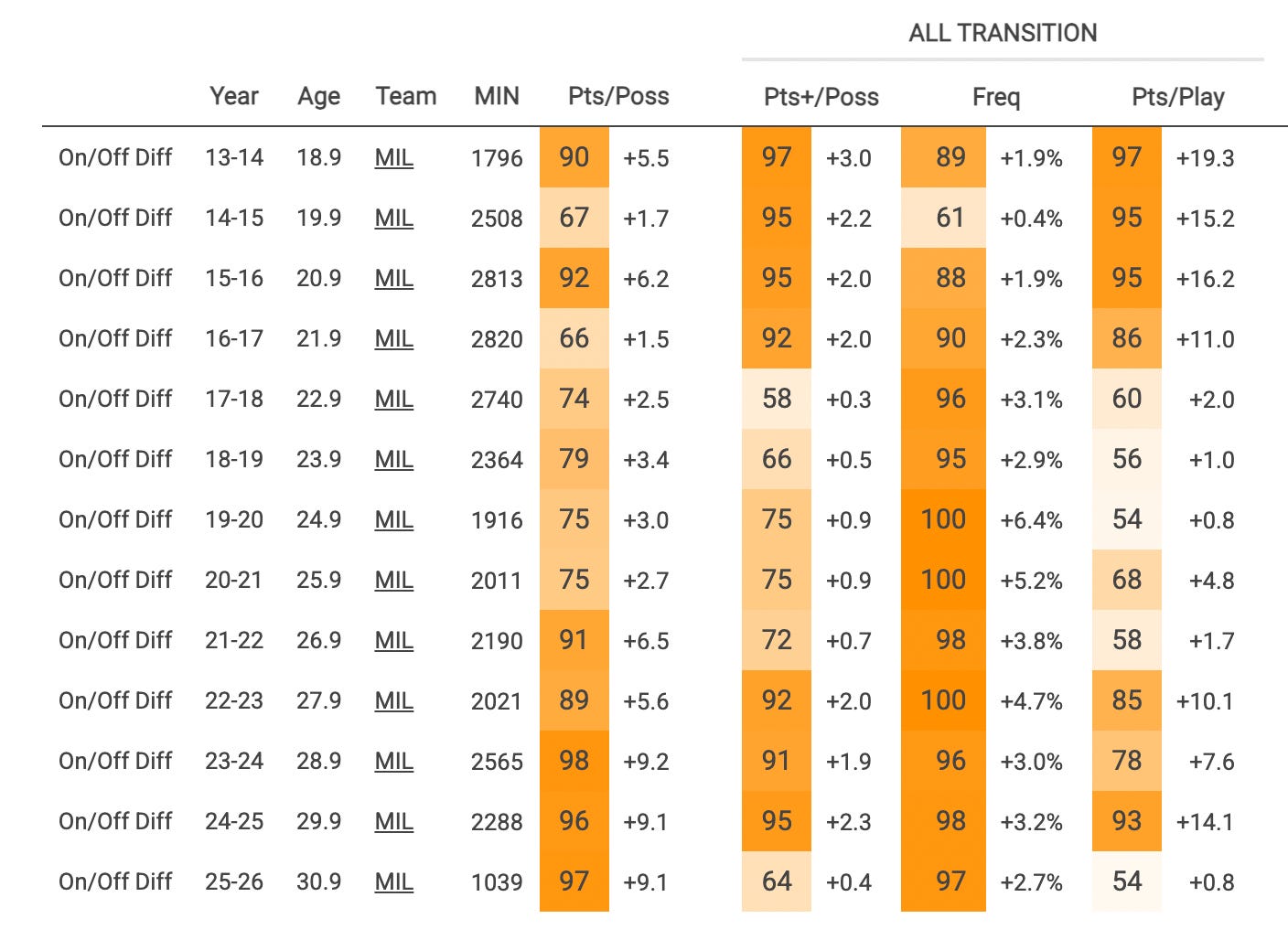
Part of his interior dominance transpires on fast breaks, too. Last season, Miami was second in transition frequency but 18th in points per 100 transition possessions (125.0), per Cleaning the Glass. Antetokounmpo is a vigorous open-court heartbeat unto himself. He’ll maintain the Heat’s uptempo preference while improving their efficiency. His transition track record is sparkling:
With roughly four months until the 2026-27 regular season commences, Miami owns a lengthy runway to fill out its roster. It’ll need to nail some moves on the margin to invigorate its ball-handling depth, which is rather depleted (a tradeoff you accept to bring in Antetokounmpo). And it seems like the wheels have already been spinning prior to Monday night:

Tyler Herro was its best perimeter creator and among its best shooters. Jaime Jaquez Jr.’s early offense drives and mismatch scoring lathered up the offense. Kasparas Jakučionis drilled 42.3 percent of his 3s as a rookie, and is a witty off-ball mover and a spunky drive-to-pass attacker (excited for him to get extended run with the Bucks!).
The remaining options in the cupboard are tenuous.
Davion Mitchell’s driving and passing are vital — his downhill fervor and interior facilitating should grant Antetokounmpo some clean at-rim chances — but his limited scoring arsenal narrows the scope of his ball-handling imprint.
Norman Powell, if he returns in free agency, is much better served as an off-ball extraordinaire than a voluminous creator. Andrew Wiggins, if he exercises his player option, is a spot-up shooter, cutter and second-side attacker. Pelle Larsson is an off-ball driver and playmaker.
Of course, the offense will primarily flow through Antetokounmpo and Adebayo. But Miami must surround them with complementary perimeter scorers and ball-handlers to ease their burden and allow them to begin touches inside the arc — where their size, strength and mobility shine brightest — rather than cosplay as full-fledged offensive engines kickstarting possessions up top.
Just how great can Miami’s defense be?
Amid all the offensive consternation the Heat have endured over the years, they’ve stayed in the playoff hunt because of a feisty, pestering, adaptable defense, finishing among the top 10 in defensive rating 10 of the past 11 seasons, per Cleaning the Glass.
That shouldn’t change in 2026-27. Antetokounmpo, Adebayo, Mitchell, Wiggins and Larsson are a stout, synergistic top five defensively. Within that group is a bunch of size, mobility, physicality and effective screen navigation. Most relevantly, in Antetokounmpo, there’s size alongside Adebayo, which has not often been the case during his NBA tenure.
Although Ware experienced plenty of defensive growing pains — namely, lack of discipline as a shot-blocker, easily being dislodged for rebounding positioning, mercurial awareness in help — the Heat were a staunch unit whenever he shared the floor with Adebayo across two seasons together. Their two-pronged size barricaded the rim for opposing offenses.
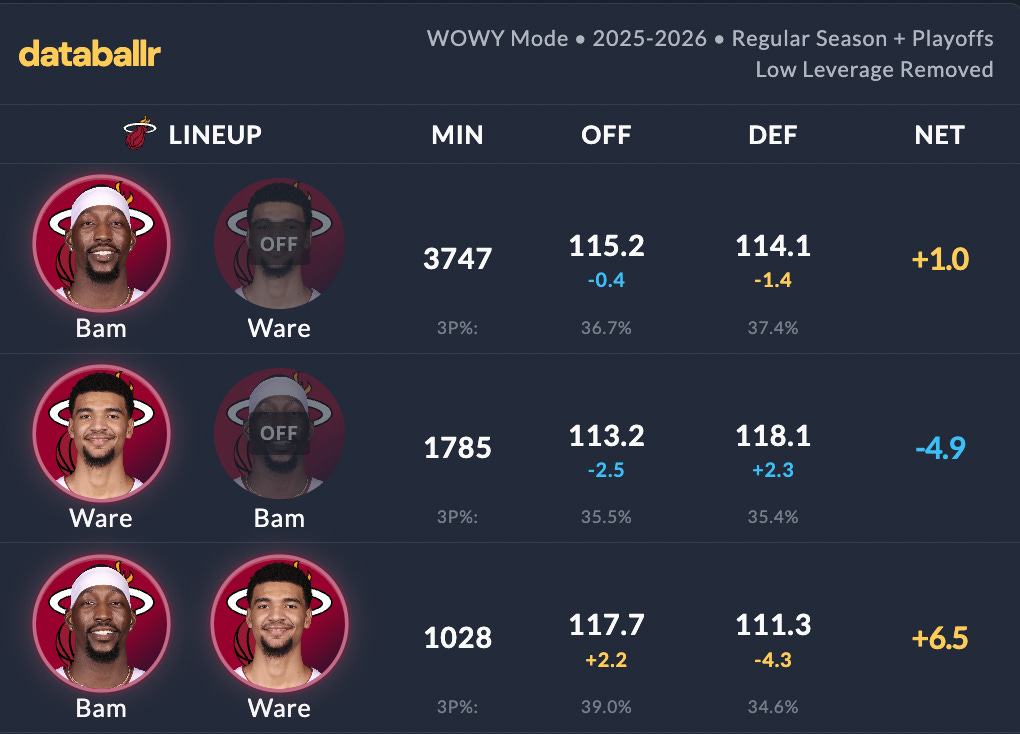
Antetokounmpo’s execution and diligence have regressed from his All-Defensive, DPOY-winning days but he’s still a substantially better defender than Ware. His length, help-side rotations and moderate switch-ability should elevate the ceiling of Miami’s defense and broaden its schematic possibilities with Adebayo at the helm.
Adebayo is optimized when involved in as many actions as possible. Switch him into every screen. Let him overwhelm ball-handlers with his size and lateral quickness. Envelop passing opportunities. Erase driving lanes. Contain the ball. Keep the paint vacant. His super power is prevention, not rim protection — exactly where his new running mate enters the conversation.
It’s easier to embrace all that and deploy him as a pinball of perimeter destruction without worries about backline consequences if Antetokounmpo is insulating him. However, maximizing that approach requires levels of punctuality and activity from Antetokounmpo than he’s exhibited in recent seasons.
Miami’s hopes of rocketing up the hierarchy of the Eastern Conference are founded upon an elite defense anchored by its front-court. That’s only possible if Antetokounmpo holds up his end of the bargain to amplify the impact of everything Adebayo can do by doing everything he’s previously shown capable of doing.
It’s especially imperative Antetokounmpo re-establishes himself as premier defender if he enters the season as Miami’s backup 5. If that’s the case, it’ll reduce how often he and Adebayo play together by sheer virtue of rotation patterns and the need for one to man the fort inside while the other rests (I’d anticipate a reinforcement or two in this area).
Yet when they do play together, I’m additionally intrigued by those shapeshifting zones the Heat love to spring on teams. Last season, Antetokounmpo praised the conundrum with which it confronts opponents.
Moving forward, he’ll get to augment that conundrum instead of attempting to solve it. I can’t wait to see how zone configurations including Adebayo and Antetokounmpo look. That’ll be an abundance of range, length and size blanketing the court.

During Adebayo-Antetokounmpo minutes (which I presume will compose roughly 30-40 percent of each game they’re both active in), I wonder if Miami feels emboldened to capitalize on its defensive titans and dial up the takeaway-hunting. After ranking near the top of the league in opposing turnover rate for a few years, it’s sunk below the middle of the pack recently.
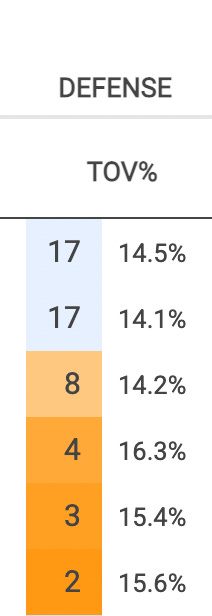
Much of that is linked to a talent drain prompting more conservative rotations, particularly Jimmy Butler’s midseason exodus in 2024-25. With Antetokounmpo around and, ideally, equipped to cover breakdowns elsewhere — just as Adebayo is — maybe the Heat coaching staff encourages its perimeter players to pursue more risks and pilfer possessions away from opponents.
The scheme could certainly be somewhat different and, in Miami’s optimistic, ambition-laden eyes, better than past seasons, even those when it finished top five in defensive rating (2021-22, 2023-24).
From my vantage point, Antetokounmpo, with this team, is a floor-raiser offensively and ceiling-raiser defensively — the offensive catalyst and a defensive cog. The Heat desperately needed those elements to rise above their disappointing 2024-25 and 2025-26 campaigns, which featured zero playoff victories. Antetokounmpo hasn’t experienced much postseason success either lately, failing to win a single playoff series since 2022-23.
Together, these sides will hope joining forces rectifies their respective droughts and elevates them back into contention out East.
bro saved my life