
What does Jaylen Brown change for the Sixers?
Breaking down how Philadelphia's newest star will fit in the City of Brotherly Love

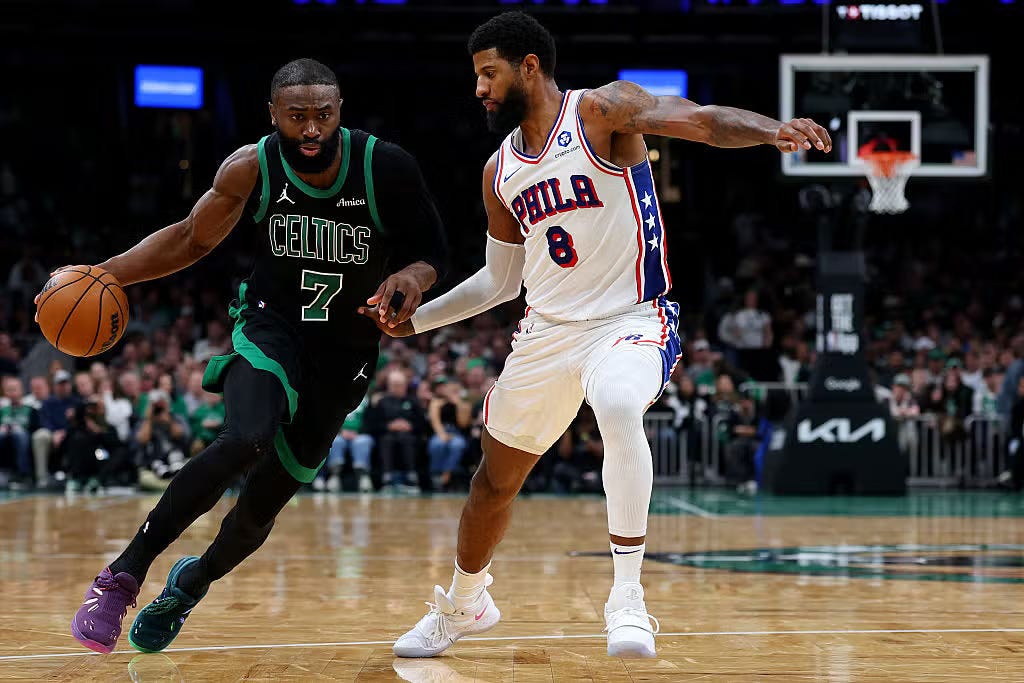
Fewer than two months after dispatching his Boston Celtics in the first round, surging back from a 3-1 series deficit for a dramatic turnaround victory, the Philadelphia 76ers are electing to acquire All-NBA wing Jaylen Brown.
According to ESPN’s Shams Charania, Philadelphia will send Paul George, two first-round picks and two second-round picks to the Celtics in exchange for the five-time All-Star. Specificity on those picks is detailed here:


Brown is a better player than George. He plays far more often (134 games vs. 78 games the past two regular seasons). He’s made two All-Star appearances since the last time George did and earned an All-NBA spot last season, something George hasn’t achieved since 2020-21 (Brown also did it in 2022-23). He is 29 years of age, 6.5 years younger than the 36-year-old George, signaling a much smaller likelihood any imminent drop-off might occur.
Despite all that, I feel rather ho-hum about this deal for the Sixers, which is not to say I consider it a catastrophe or unequivocally bad. I just don’t think it does much to shift their standing in the Eastern Conference, which should always be the goal of a trade when you import a certified star and move two first-round picks to do so.
There are undoubtedly benefits to swapping George for Brown. Chief among them is the considerable gap in volume scoring and faculty for shouldering a high-usage offensive role. Last season, Brown averaged 30.9 points (57.5 percent true shooting) per 75 possessions, sported a 35.2 percent usage rate and was assisted on 36 percent of his field goals. George averaged 20.6 points (57. 2 percent true shooting) per 75, sported a 23.3 percent usage rate and was assisted on 55 percent of his field goals.
Relevantly, Brown was tabbed to spearhead Boston’s offense most of the season without Jayson Tatum available. He will not carry as heavy an offensive burden alongside Tyrese Maxey and Joel Embiid; granted, his ability to scape up will likely prove resourceful, given Embiid’s unfortunate injury history.
The year prior, when Tatum was fully healthy and Jrue Holiday and Kristaps Porziņģis were still around, Brown averaged 23.8 points per 75 (55.7 percent true shooting) with a 28.3 percent usage rate and 46 percent of his field goals assisted— all of which are still notably different than George’s 2025-26 marks.
Absorbing usage and producing moderately efficiently on it are skills. Brown touts them. That should pair well with Maxey, who’s routinely been overtaxed (on the ball) in recent seasons, regardless of whether George and Embiid were in the lineup. His 28.8 percent usage rate ranked in the 95th percentile last season, a slight decline from 29.3 percent (96th percentile) in 2024-25.
There is also surely some intangible value to providing Maxey with a star-caliber player who rarely misses games. He’s undeservedly soldiered through a lot of suboptimal, shorthanded contexts in recent years while co-stars were sidelined. Brown has his on-court warts but the dude almost always plays, just like Maxey. It’s good to reward that.
Beyond the overarching difference in offensive involvement, the means through which Brown etches his scoring signature in contrast to George could behoove the Sixers’ attack. His quick-hitting forays and early offense cuts were a steady, irreplaceable stream of points most nights for the Celtics. They can be in Philadelphia, too.
Last season, 53 percent of his field goals occurred below the foul line (14 feet and in, essentially all shots in the paint), according to Cleaning the Glass. The three previous years, those shots comprised 58 percent (2024-25), 57 percent (2023-24) and 54 percent (2022-23) of his total attempts.
George’s tallies over that same span? 33 percent (2025-26), 32 percent (2024-25), 35 percent (2023-24) and 40 percent (2022-23).
Both the Clippers and Sixers regularly took a smaller share of their shots at the rim with him on the court during the past four seasons…
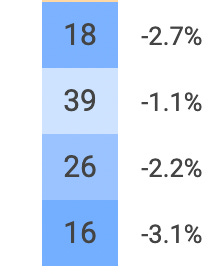
…while the Celtics attempted a greater portion of their field goals at the rim with Brown on the court every season of his 10-year career in Beantown:
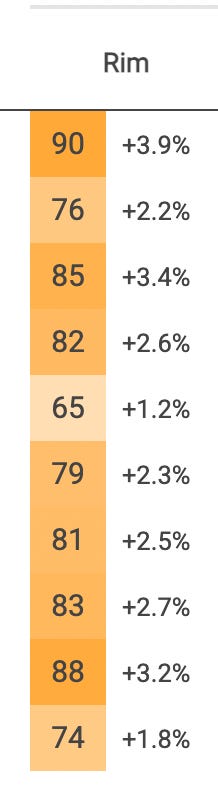
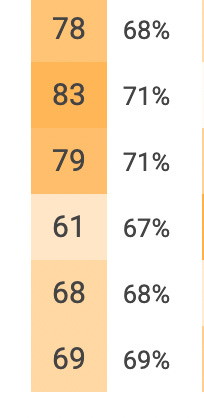
Last season, Philadelphia ranked fifth in rim frequency but just 28th in efficiency. George converted 55 percent (ninth percentile) of his shots there. Brown made good on 69 percent of his, continuing a six-year trend of him being damn good around the basket:
I’m intrigued by Brown’s arrival potentially boosting Maxey’s off-ball prowess. He is among the leagues’s elite off-ball movers and scorers but Philadelphia’s surrounding personnel has not always let him to flourish that way. Inverted pick-and-rolls (he’s a very good, sturdy screener!) or ghost screen actions with Brown could be a path toward greater deployment in that role.
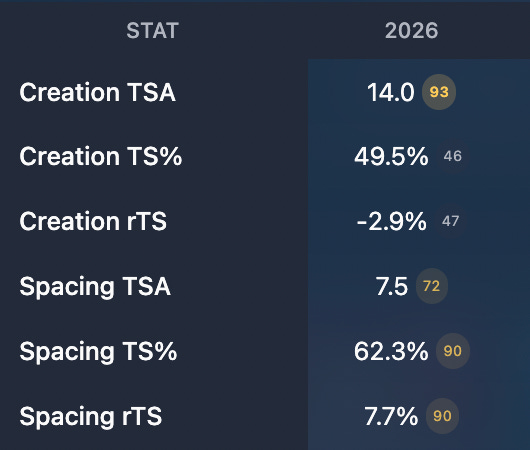
Maxey can and will maintain gaudy offensive usage but it must be better allocated to maximize him. Look how well he fared in spacing play-types (spot-ups, handoffs, off-screens) compared to creation play-types (pick-and-rolls, isolations, post-ups) last season. Bridging the divide in volume should be a focus with Brown around now…
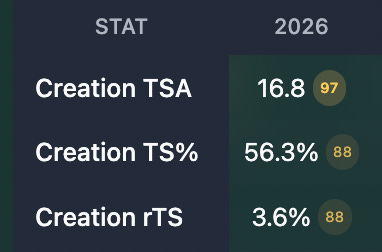
…particularly because Brown was quite the creator in 2025-26 and can siphon some of the load from Maxey:
Perhaps, George’s offensive role never reaching true star levels with the Sixers was out of caution and preservation for his health. The durability upgrade Brown provides is significant and among the foremost reasons he’s a much better player (George was very good — before and after his 25-game suspension — when healthy in 2025-26).
Although George actually ranked higher than Brown in a per-minute impact metric like Estimated Plus-Minus last season (plus-2.6 to plus-2.2), he ranked well below in EPM’s cumulative component, Estimated Wins, which said Brown generated 8.7 wins to George’s 4.3. That’s an enormous gap, the difference between 30th and 101st, All-Star-caliber wing versus below-average starter.
Brown’s availability will ideally elevate Philadelphia’s regular-season floor and strip away some of its volatility. Building around two oft-sidelined players on max deals was untenable and a disservice to Maxey, the franchise guard. I recognize the value of stability Brown’s high-level, reliable play brings.
Yet even acknowledging the widespread appeal Brown’s acquisition can instill, I simply remain uninspired by the move. I do not believe he reshapes or heightens the Sixers’ ceiling among their Eastern Conference contemporaries.
George’s first-round performance against Boston displayed how his shooting, secondary creation and malleable defense could invigorate Philadelphia’s postseason aspirations. I understand his inconsistent health. I am not advocating against trading him and his contract.
The goal, however, of any move for a star like Brown should be to raise the ceiling. I do not think that was accomplished. Instead, it hamstrings the Sixers’ future flexibility as Maxey and V.J. Edgecombe enter their primes, added another longer, outsized contract to the books (albeit, for a better player) and enforces some daunting team-building weaknesses within the core.
For as many problems as Brown may solve (secondary driving, voluminous scoring, Maxey’s preferred usage), George’s departure in favor of him presents plenty other woes. And now, they have fewer avenues to address them, given Brown’s contract (three years, $182.9 million remaining) and the two first-round picks doled out to land his services.
I am skeptical of any team so light on passing, rim protection, feel and shooting as the Sixers project to be; that is an arduous deficit from which to produce fortuitous playoff runs.
Brown is heralded as an elite defender, a label he garnered many years ago, but one I don’t consider accurate. While he authors flashes — his work against Luka Dončić in Game 1 of the 2024 Finals was marvelous — he’s a mercurial on-ball defender and screen navigator. His execution in those regards, supposedly the standout traits and basis of his superlative defense, ebbs and flows from game to game and play to play.
He’s liable to be caught flat-footed and burned off the bounce or entangled in a screen, unable to stay attached to his assignment. A high center of gravity limits his ability to guard up positionally (Embiid, for instance, spotlighted this in May’s Game 7). Burlier wings and bigs can dislodge him because he’s not anchored low to the ground entirely engaging his core strength. It’s something defenders like Jrue Holiday and OG Anunoby excel at, massive reasons they successfully guard larger players and toggle across lineups with their assignments.
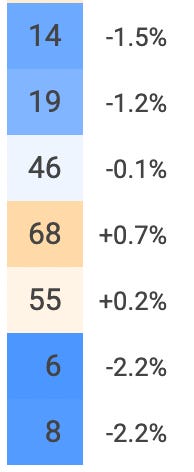
Off the ball, he’s not particularly instinctive. Lapses in focus hinder his impact. Screen navigation struggles crop up there as well. According to Cleaning the Glass, Boston’s opposing turnover rate has been worse with him on the floor in five of the past seven years, including a stark dichotomy the past two seasons:
George, meanwhile, has long been a superb defender and was during his tenure in Philadelphia, even if he ascended to a new level following last season’s suspension. His blend of size, mobility, flexibility and instincts is a rare profile.
He can wiggle around screens glued to his man and cranes his 6-foot-9 frame over top to distort passing or shooting angles. He prompts takeaways on and off the ball; his 2.3 percent steal rate last year ranked in the 89th percentile among wings, the lowest he’s ranked since 2020-21. He’s a viable help-side rim protector, a necessity with Embiid’s regression as an interior defender.
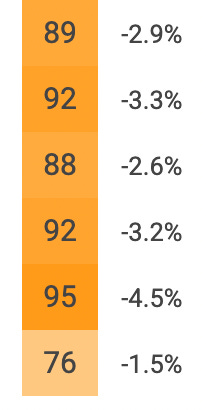
Dean Wade can assume many of the point-of-attack duties George held — and is splendid at them — but I’m dubious he or Brown will replicate the interior presence. George’s feel and physical gifts have helped his teams concede fewer shots around the rim for years whenever he’s on the court:
As much as Brown represents an upgrade upon George’s timid downhill scoring, he’s a significant downgrade beyond the arc. For his career, he’s a 35.8 percent 3-point shooter with a .341 3-point rate. George is a career 38.4 percent outside shooter with a .424 3-point rate.
Brown doesn’t frequently fire around screens or on the move; George does, and lucratively. Brown’s netted 34.8 percent of his catch-and-shoot triples the past three years; George has netted 42.8 percent of his (40 percent as a Sixer).
Brown is a fine spacer lacking considerable versatility whom opponents can live with taking long balls. George is an excellent spacer with considerable versatility whom opponents absolutely do not want taking long balls. That will alter the types of defensive coverages Philadelphia sees moving forward.
Even with George, effective, voluminous outside shooting was an issue for the Sixers last season. Only George (traded), Eric Gordon (non-rotation player) and Jared McCain (traded) wielded a 3-point rate north of 40 percent while hitting at least 37 percent of their 3s (Maxey just missed the cutoff with a 36 percent rate). They were already 23rd in 3-point rate before dealing George and did not succeed him with a comparable alternative.
*As I wrote this piece, news broke that the Sixers will reportedly sign Anfernee Simons. His career 38 percent outside clip on a .535 3-point rate, with range and diversity, will help Brown and Philadelphia in this department.
The Sixers’ spacing constraints are another worry for Brown’s translation. Boston constructed (in)arguably the NBA’s most well-spaced lineups the past few seasons, enabling him to thrive as a driver, midrange practitioner and face-up scorer.
That freedom won’t exist in Philadelphia. Whether it’s helping off the strong-side to prod at his rickety handle or loading early near the rim from the weak-side, fewer teams will stay home, less fearful of long-range repercussions via his teammates. His ball-handling and passing will be challenged more frequently. Neither are strong points of his game.
Philadelphia’s collective passing quality is troublesome. Maxey has improved but is still pretty poor, consistently missing opportunities on drives and impeded by his smaller stature to find cross-court outlets (his tremendous turnover suppression does benefit from these habits, in fairness).
Brown’s scoring pursuits seemingly dominate his decision-making and his lack of dextrous ball-handling prevents him from many live-dribble reads. He’s prone to try contested midrange looks, which he’s adept at and comfortable with, rather than kick it out or thread interior feeds for open shots. Most of his assists are pretty mundane. Rarely does he exploit a crease the defense would rather not concede. The same goes for Maxey.
Great passers and passing teams find and punish those openings. George, though somewhat sloppy, locates such openings better than Maxey and Brown, whether it be lay-downs, wraparounds, skip passes or otherwise. Philadelphia’s offense will miss his playmaking verve.
Brown is a very good player. Unfavorable on-off data and imperfect catch-all metrics do not define him, just as I do not deem his 2024 Finals MVP or sixth-place MVP finish this past season as perfect summations for his league-wide standing.
Beyond those singular numbers, though, is more granular data that helps quantify both his on-court wonders — such as mad-dash driving or big-time creation — and on-court shortcomings — such as defensive inactivity or a narrow passing scope.
Together, they reflect a flawed star with tantalizing highs and unmistakable lows. The highs will absolutely help the Sixers. But the lows leave me hesitant it’ll be in a manner that distinguishes them from anything the prior iteration of this team could fulfill — and with fewer ways to change that reality in the near future. The result then, as I see it right now, is a shrug-your-shoulders conclusion.
with anfernee signing they get another great shooter off the catch and dribble who can create from time to time….. this is looking gooood